
Welcome to the new — or rather — old regime!
According to some, ‘2026 is the new 2016’. At least, that’s the mantra circulating on social media platforms, and dare I say, a perfect example of aestheticised nostalgia in practice.
As new social media trends begin to fizzle out, young people find solace in the past, the glory days, and social media algorithms have latched onto this trend. Clearly, for many of today’s young people, the grass is always greener on the other side. But is it?
The Rose-Tinted World of Social Media Nostalgia
Now, my concern doesn’t question those who’ve lived through the relevant eras or merely appreciate their quirks (I know I’ve got a soft spot for those ‘Tumblr Girl’ playlists). Rather, my unease arises when I see young people increasingly living out their childhoods through flashbacks of social media nostalgia. Given the consumerist aspect of reviving and devouring past cultural trends, this tendency is neither spontaneous nor harmless.
Youth culture is known for being universally sensitive. The bulk of young people’s identities is moulded by past and present moments. But as digitalisation grows, young people primarily encounter the past through the lens of social media. The problem lies not in using it, but in how the embedded ’nostalgia’ becomes a formative source of exposure for the youth. Research shows that more young people are accessing history through a glamourised online lens, rather than books or other sources, such as their parents. I am tempted to call this algorithmic persuasion, because history becomes whatever they see in their social media feeds. And if social media happens to frame history as emotional, visual, and simplified first and foremost, how can the youth know any better?
In Sociology, this is known as media framing; when algorithms in pursuit of engagement strip context, conflict, or contradiction from historical eras. The revival and dominance of controversial eras is proof of this tendency. From ‘cottage core / trad life,’ ‘Y2K,’ and ‘pre-internet,’ young people are learning about the past through a regurgitated, one-dimensional and often promotional aesthetic filter. This ‘illusion of truth’ effect results in a gross misrepresentation of history, with serious consequences on young people’s subjective impressions and understanding.
God, They Were So Skinny in the Noughties …
Nostalgic portrayals on social media often omit or downplay prevalent cultural issues of the time. For instance, there has been a rise in pre-2010 nostalgia, evident by the iconisation of former Victoria’s Secret models. However, do a little digging, and you’ll discover that there was indeed something ‘in the air in the 2000’s,’ namely, the normalisation of body insecurity culture and eating disorders. However, enter social media’s magic wand, and a so-called restorative but also regressive nostalgia unfolds, where the youth scorn the ‘inferior present’ of body positive models and wish to return to the glamour of size-0 bodies — a beauty aesthetic overwhelmingly shaped by tabloid misogyny.
A 2023 report on ‘Theorising Regressive Nostalgia’ argues that, alongside nostalgia’s power to ‘delight and enchant’ consumers, negativity also proves to be at ‘the heart’ of many current narratives. Unsurprisingly, aggression and exclusionary tendencies have become part and parcel of today’s social media nostalgia. The same or similar harmful pressures have been subtly reintroduced into contemporary youth culture, making young people more critical of others and themselves.
As young people grow used to social media borrowing chunks of history while actively suppressing any underlying tensions, they naively internalise a past and feel nostalgia for something that simply never existed the way they imagine it. This can descend into ‘pseudo-nostalgia, ’a phenomenon where young people develop emotional attachments to eras they never lived through. This is especially worrying as it can weaken their connection to actual lived experience in favour of media-manufactured cultural narratives.
One-Sided Politics
As youth identity forms in a socially volatile climate, the nostalgia young people aim to escape to can leave them susceptible to socio-political rhetoric, influencing not just how they relate to themselves, but how they engage with differing viewpoints. Today, social media has emerged as a powerful tool for persuasive communication, with an overwhelming ability to steer young people’s political opinions. A 2022 Deloitte article reveals that approximately 51 per cent of Gen-Z teenagers consume their news and political coverage through social media platforms like TikTok and Instagram, a trend that hasn’t seen any significant reversal.
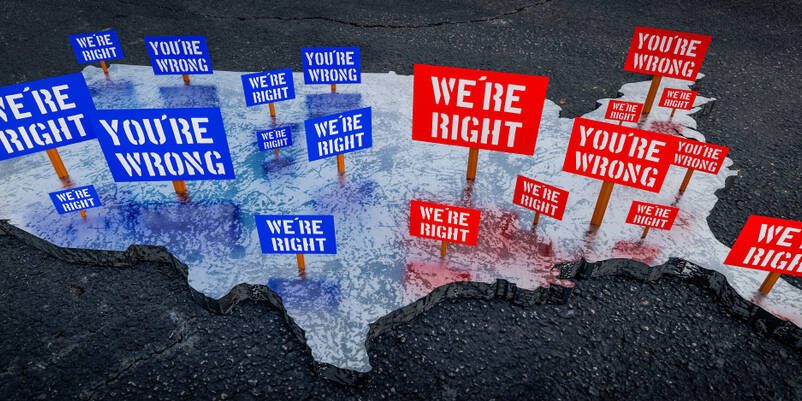
Social media algorithms opt to either push certain political narratives or exploit a confirmation bias in young people. This has resulted in a culture where a growing number of youth prefer to aggressively engage with just one side of politics rather than partake in healthy debate. Weaponising nostalgia through political reminiscence — ‘if only we could go back to X ideology and Y values’ — has helped to accomplish this characteristic tunnel vision. This is also where social media uses curated nostalgic imagery as a vehicle for political indoctrination, disguised in an idyllic light. A housewife comfortably raising children on a farm can easily evoke conservative ‘traditional family values’ or white Christian nationalism — a popular online theme via influencers like Nara Smith. And so, a young generation begins to define itself through second-hand sentiment evoked through appealing slivers of the past — a past that aims to subtly influence.
How the Youth Respond to Political Memory
Highly relevant in today’s context, nostalgia in social media serves as one of the most compelling communication strategies used by modern right-wing populists across the globe, notably in the reinstatement of Donald Trump as president in 2024. His political success can be attributed largely to having effectively utilised nostalgia, convincing voters that America’s future lies in reviving the past, hence the slogan: ‘Make America Great Again.’
By now, I’m sure you’ve heard these four words, underpinning his presidential social media campaign, many times. They have created some of the strongest divisions between young people in America today. Being an avid ‘doom-scroller’ during the election period myself, the comment section was suffocated with nostalgic sentiment where young people from 13-22 harkened back to his 2016 presidency. This nostalgia for the return of ‘better days’ and the absence of critical self-reflection resulted in significant numbers of voters turning against Kamala Harris. The rest you know.
Nostalgia as Power Over Young Minds
Generally, when taken in small doses and tempered with sober reasoning, social media nostalgia is not inherently harmful. However, we cannot ignore its sheer impact on young people as they shape their lives and sense of self. Youth culture is gradually becoming more fragile as idealised nostalgia gets neatly packaged into political rhetoric and cultural identifiers, leading to identity hollowing. This is something we need to watch closely and tentatively.
DISCLAIMER: The articles on our website are not endorsed by, or the opinions of Shout Out UK (SOUK), but exclusively the views of the author.