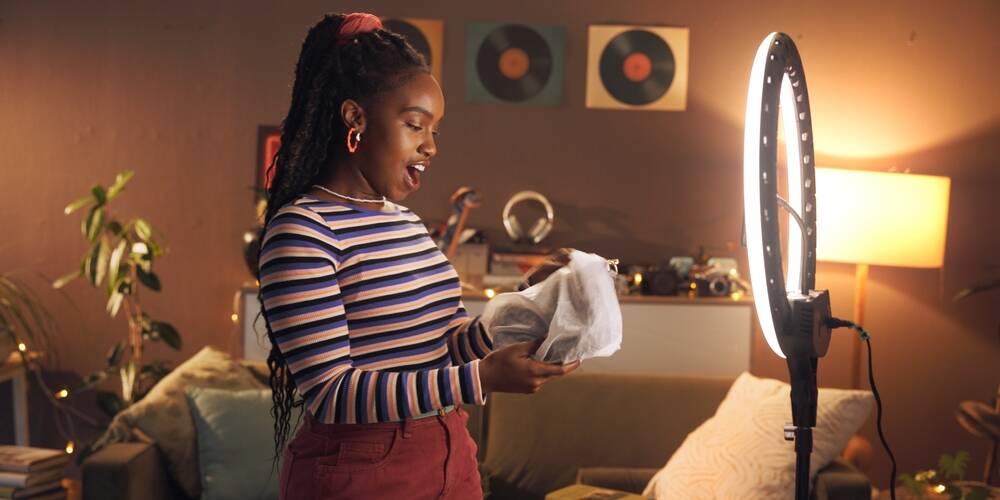

A girl snuggles up on the sofa to journal and rewatch her favourite TV shows whilst eating pizza. ‘POV,’ the video’s caption reads, ‘you have no friends and live alone, so this is how you spend your Friday night.’
We would often interpret this negatively. But is that the right response? Some people genuinely prefer solitude. Hence, the rise of a niche range of content creators: loneliness influencers.
Alone, Not Lonely
Loneliness influencers, most of whom are women, command impressive followings by documenting their day-to-day lives as single, friendless, and childless people. Take 24-year-old Lana Isa from Canada. Isa found fame by posting videos of herself happily performing mundane tasks like cooking and cleaning as a single woman. Then there’s 36-year-old cat-lover Paulina Cee. Cee has amassed 374K Instagram followers by creating content ‘for girls who’d rather be home’ in her New York apartment.
But this kind of content didn’t come out of a vacuum. From COVID comedy, which poked fun at our lockdown responses, to the rise of cottagecore and goblincore, which idealised solitary pursuits like birdwatching and spending time alone in nature, this trend has been a long time coming. And the facts back this. According to the Office for National Statistics, a quarter of Brits (27%) report feeling lonely ‘often.’
In the UK, 40-year-old Sarah Hoadley is one such loneliness influencer. She claims that she started her account to remove the stigma around being introverted and to help others like herself feel less lonely.
Hoadley says that younger ladies who have recently moved out and mothers with empty-nest syndrome form the core of her audience. It is easy to understand why this content appeals to them. Beginning a new chapter of life often means losing contact with people you once knew and starting afresh in a place where nobody knows who you are. There is nothing wrong with that. But choosing to prolong solitude instead of making new connections is not the way forward.
Women are often stereotyped as being more sociable. Many will equate their worth with the number of friends they have or the length of their contact list, even if these connections are shallow. One likely reason why people gravitate towards loneliness influencers might be because they unashamedly buck the idea that quantity equates with success. However, we must tread carefully. Loneliness content may seem empowering at first, but the reality is that it’s a temporary band-aid. For many of us, loneliness is not a choice but a reflection of our circumstances. It can often manifest when you’ve moved house, changed jobs or schools, had a bereavement, or when you’ve become unemployed, divorced, or been disowned.
The increasing digitalisation and corresponding alienation of our society is another contributing factor. Tech oligarchs claim to have made the world more interconnected, yet this could not be further from the truth. One in three children talk or play with strangers online, yet one in 20 report having no close friends at all. The internet can bring anyone together, but we can never fully know the people we’re communicating with. We are typing more, yet talking less. A study recently published in The Atlantic highlights this. From 2005 to 2019, a group of researchers followed over 2,000 participants between the ages of 10 and 94. They wore devices that randomly recorded their voices, revealing that, on average, participants spoke 338 fewer words each year.
Digitalisation is not just reducing the chances of meeting potential friends and partners face-to-face; it is also robbing us of fleeting opportunities to chat. The cashier has been ousted by the self-checkout machine. The taxi driver could soon be replaced by self-driving cars. The decline of third spaces reduces the ability for people to meet up IRL. Businesses are even capitalising on the loneliness trend by offering ‘hushpitality’ holidays purposely devoid of human interaction. In other words, the tendency towards isolation, decreased live interaction, and social withdrawal is only increasing as technology and big businesses force us to adapt to an increasingly automated world.
Effects of Isolation
Craving serenity is not a bad thing. Taking some time out to go for a walk or read a book has been known to benefit our mental and physical health. But prolonged loneliness has a detrimental effect on the body, equivalent to that of smoking fifteen cigarettes a day.
As a sociable species, being alone triggers our fight-or-flight response (even in people who enjoy their own company) and causes the release of cortisol. People who live alone and have little interaction with the outside world, therefore, suffer from a chronic release of stress hormones, reducing the body’s ability to regulate inflammation and recover from illness or injury. This explains why married people have better cancer survival rates, why those who don’t live alone live longer after they have suffered a heart attack, and why people who converse more are less likely to develop dementia. Even owning a pet reduces cardiovascular risk.
Neuroscientist Ben Rein explains all of this in his book Why Brains Need Friends. But he isn’t the first person to tout the benefits of social connection. Renowned psychologist Abraham Maslow included ‘belonging’ in his Hierarchy of Needs, only below essentials such as food, water and safety. Modern influencers claim that you need to love yourself before you can love others. But according to Maslow, people need to have a community around them before they can progress towards working on their self-esteem or try to achieve self-actualisation. We can see this happening in the real world, where people are actively attempting to buck the global loneliness trend.
In rural areas of Spain, it is common for residents within the same neighbourhood, particularly older women, to sit outside their front doors in the evenings and chat with each other. Many South American nations are referred to as ‘peach cultures’ because the people tend to be warmer and more welcoming to strangers than in other continents. In the West, youngsters have come up with inventive ways to circumvent the loneliness crisis, from meme-inspired raves and kidult Lego clubs, to date-my-mate meet-ups and screaming sessions, where young people come together in parks to relieve their frustration by, well, screaming.
Social events involving music, whether that be in a church or at a concert, have been proven to generate a sense of ‘collective effervescence.’ It doesn’t matter whether people are in different age groups or speak different languages; as long as they are present together, dancing to the same rhythm, they are elevating their social closeness and boosting endorphins. Perhaps that’s why a recent University of Leeds study found that 91 per cent of midlife women feel that clubbing improves their wellbeing.
The loneliness trend is ultimately our way of trying to put a positive spin on the increasingly isolated world in which we find ourselves. But instead of recording ourselves cooking up a frozen pizza, we ought to be finding solutions to the loneliness crisis. If not for the sake of our mental health, then at least to boost our physical wellbeing, we owe it to ourselves to make an effort to engage with the world and its people.
There is nothing wrong with finding happiness in solitude. But even those who prefer their own company still need a safety net. Whether that’s your friends, partners, family or neighbours, a little bit of in-person TLC can go a long way. And before you know it, those comforting homemaking videos might no longer be what you need.
DISCLAIMER: The articles on our website are not endorsed by, or the opinions of Shout Out UK (SOUK), but exclusively the views of the author.